Explain Different Constraints to Maintain Data Integrity in Sql
Data integrity is essential because it is a necessary constituent of data integration. How to get a list of table columns using the sp_columns stored procedure in ms sql server.
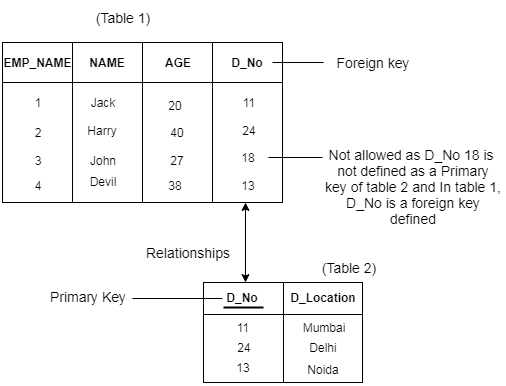
Dbms Integrity Constraints Javatpoint
SQL Integrity Constraints.
. Entity integrity referential integrity and domain integrity. Typed tables have two different types at the same time. Polaris Wipro I also Faced.
Specifying that the columns of table DEPT also have nulls not allowed is not so easy. This is also one. Check constraints will be useful to limit the range of possible values in a column.
A primary key is a field in a database table that uniquely identifies each rowrecord. Data integrity is handled in a relational database through the concept of referential integrity. Referential integrity concerns the concept of a foreign key.
What are the two types of constraints. Primary key Unique Key. Explain different constraints to maintain data integrity in SQL Server.
Different SQL Constraints and Usage. Whenever two tables contain one or more common columns Oracle Database can enforce the relationship between the two tables through a referential integrity constraint. Types of Integrity Constraints in SQL.
The following constraints are commonly used in SQL. Entity integrity concerns the concept of a primary key. Answer Posted hari.
We could create check constraints at two different levels a Column-level check constraints are applied only to the column and cannot reference data in another other column. Integrity in a database means that processes such as insertion update and other processes do not affect the accuracy and consistency of data in the database. We review their content and use your feedback to keep the quality high.
A unique constraint restricts a column or combination of columns from allowing duplicate values. NOT NULL Constraint UNIQUE KEY Constraint Default Constraint CHECK KEY Constraint PRIMARY KEY Constraint FOREIGN KEY Constraint. This is also a.
Constraints are important to maintain the integrity and effectiveness of the data we have in our database over time. Foreign keys help ensure the consistency of your data while providing some ease. If data integrity is maintained data values stored within the database are consistent about the data model and type.
A database can enforce these rules using Check and Default constraints. The following constraints are commonly used in SQL. Integrity constraints are simply a set of rules that maintains the integrity or.
Constraints are used to limit the type of data that can go into a table. MySQL supports the following six types of constraints for maintaining data integrity. We can apply this using a Foreign Key constraint.
Constraints on views do not help maintain data integrity or have associated indexes. Note the NOT NULL specifications on the columns of table EMP. There are many types of integrity constraints that play a role in Referential Integrity RI.
Domain Integrity Domain integrity ensures the data values in a database follow defined rules for values range and format. Show some data manipulation examples. Integrity Constraints Integrity constraints are a set of rules.
Everything You Need to Know SQL Primary key. You define data type length or size is null value allowed is the value unique or not for an attribute the default value the range values in between. Data integrity is normally enforced in a database system by a series of integrity constraints or rules.
Importance of Integrity in Data. SQL Server supports six types of constraints for maintaining data integrity. Three types of integrity constraints are an inherent part of the relational data model.
Referential Integrity Referential integrity ensures the relationship between the Tables. Data integrity is the assurance of the accuracy and consistency of data over its entire life-cycle while the SQL constraints are used to specify rules for the data in a table. Entity integrity concerns the concept of a primary key.
Define a PRIMARY or UNIQUE key constraint on the column in the parent table the one that has the complete set of column values. Entity integrity referential integrity and domain integrity. Constraints are imposed on columns of a table.
Its all just shorthand really. PRIMARY KEY - A combination of a NOT NULL and UNIQUE. Various types of integrity constraints are-Domain Integrity.
Useful Video Courses Video. NOT NULL - Ensures that a column cannot have a NULL value. UNIQUE - Ensures that all values in a column are different.
What is domain integrity in SQL Server. FOREIGN KEY - Prevents actions that would destroy links between tables. Uniquely identifies each row in a table FOREIGN KEY - Prevents actions that would destroy links between tables.
This section includes the following text. Explain different types of. 1 year agoSee more.
Default constraints enable the SQL Server to write default value to a column when user doesnt specify a value. For more information about constraints on views see Oracle Database SQL Language Reference. Integrity Constraints are used to apply business rules for the database tables.
What are the integrity constraints in SQL. The constraints available in SQL are Foreign Key Not Null Data Integrity and Protection Beyondthebasicadvancesfoundinthefilesystemswehavestudiedthus many changes in data but is not good if the data for example. This will perform by primary key on the.
Primary key constraints will allow a row to be uniquely identified. Using SQL we store data in such a. It is used to maintain the quality of information.
They are as follows Default Constraint UNIQUE KEY constraint NOT NULL constraint CHECK KEY constraint PRIMARY KEY constraint FOREIGN KEY constraint. To Restrict the voilation of irrelegular data and maintain data integrity. Thus reliable insights can then be gained from the data model so users can make informed business decisions.
Instead they enable query rewrites on queries involving views thereby improving performance when using materialized views and other data warehousing features. By using constraints we can keep our data free from ambiguity and unwanted errors. Integrity constraints ensure that the data insertion updating and other processes have to be performed in such a way.
Constraints are of two types. NOT NULL - Ensures that a column cannot have a NULL value UNIQUE - Ensures that all values in a column are different PRIMARY KEY - A combination of a NOT NULL and UNIQUE. Domain Integrity-Domain integrity means the definition of a valid set of values for an attribute.
Before understanding the constraints in MySQL first we need to understand NULL in MySQL. These constraints include Primary Key Foreign Key Unique Constraints and other constraints which are mentioned above. Three types of integrity constraints are an inherent part of the relational data model.
Understanding NULL in MySQL.

Data Integrity In Sql Server

Integrity Constraints In Dbms Scaler Topics
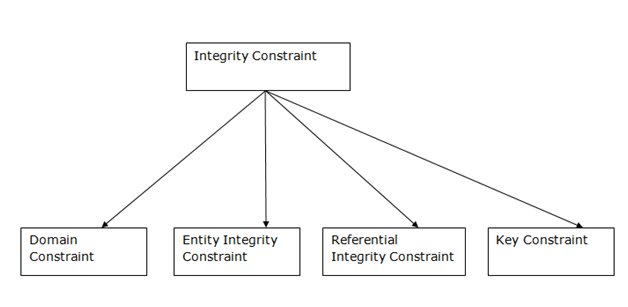
Dbms Integrity Constraints Javatpoint
0 Response to "Explain Different Constraints to Maintain Data Integrity in Sql"
Post a Comment